
Fata Morgana

"...some ignorant people think that those that can be seen on earth are witches, Lemurs,...evil women who go wandering at night,...that they transform themselves into different forms and species of animals, and that they fly to different and distant regions,...dancing throughout the countryside and the swamps..."
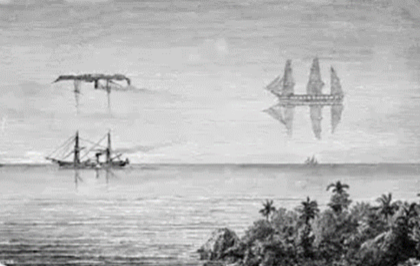
Fata Morgana

Mirages

In the XXVIII chapter of “Description of the Origins and Successes of the Province of Otranto”, Marciano deals with the appearances and phantoms seen in the seas and in some underground places in the province. He is referring to those mirages, called Fata Morgana, which can be observed under certain circumstances, especially over flooded lands like VOREs during their full phase. These phenomena then became the subject of mystery and fascination at the same time, fear, and curiosity of Marciano's fellow citizens who went to sought explanations about them.

Fata Morgana

Etymology

Fata Morgana is a complex mirage caused by the alternation of colder and warmer layers in a short space. One of the most famous places where it occurs is the Strait of Messina, and the name derives from a legend about King Arthur's stepsister, Morgana, who arrived in Sicily with him and went to live in an underwater castle at the center of the Strait of Messina to protect her brother who remained on the island. When a barbarian king arrived in Reggio to conquer Sicily, Morgana made Sicily appear so close to Calabria that the barbarian king believed he could swim across the strait. While he was swimming, however, the spell stopped, and the king drowned.

Fata Morgana

Observing a Fata Morgana

This type of mirage can be observed on land or at sea and can involve almost any distant object, including boats, islands, and the coastline. This optical phenomenon occurs because light rays pass through layers of air with different temperatures: that is, when warmer air is in a well-defined layer above a one of colder air. This temperature inversion is the contrary of what normally happens. In calm weather, a layer of warmer air resting on top of the cooler, denser air forms an atmospheric duct that acts like a refractive lens, producing a series of both inverted and upright images.
Due to the constantly changing of atmospheric conditions, a Fata Morgana can change in various ways within a few seconds, hence the name 'mutate' or 'scangiate,' literally appearances “mistaked” for real things: "These phantoms and appearances do not last long, but like the vapours that they are, in which they appear and consist, they change with the times, and change from place to place, and from one form to another..."